Drive north on College Street through Clarkton and you will pass two roadside historical markers standing about 600 feet apart, close enough that you could walk from one to the other in under two minutes. One reads "Old Brown Marsh Presbyterian Church." The other reads "Whistler's Mother." Most people who live here have driven past both a thousand times without connecting them, because on the surface they look like two unrelated footnotes: an old country church and a famous painting that has nothing obviously to do with a Bladen County crossroads.
They are not unrelated. They are the same story, told twice.
A church older than the country it sits in
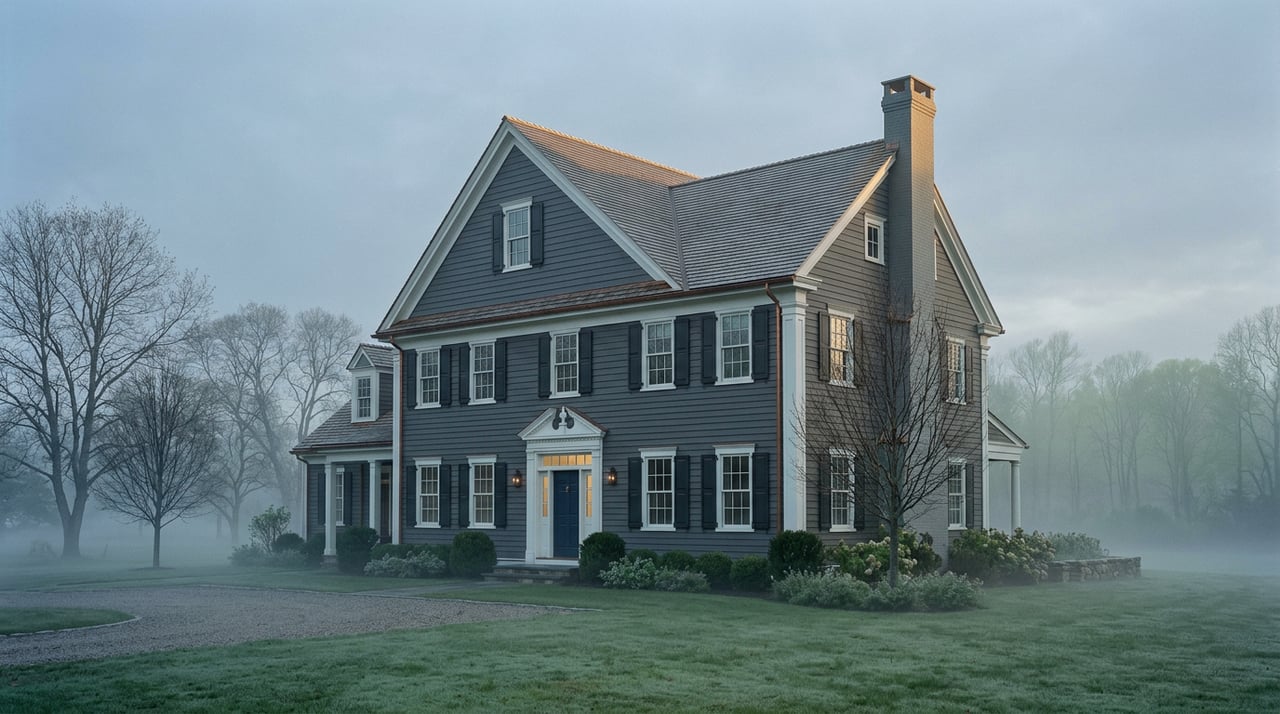
Brown Marsh Presbyterian Church, also known locally as Clarkton Presbyterian Church, is the oldest church in Bladen County. It was organized prior to 1756 by Scottish Highlander settlers, decades before the Revolutionary War reached this part of the Cape Fear region. The building standing today, at 8561 Mercer Mill Brown Marsh Road a couple of miles northeast of town, is the third structure on that same ground. The first two were built of logs. The current frame building went up in 1818 and has never been painted, which is why the National Park Service description of it notes the wood has developed what amounts to a mossy patina over two centuries. It earned a spot on the National Register of Historic Places in 1975, and the marker in town memorializing it was placed in 1949 by the Battle of Elizabethtown Chapter of the Daughters of the American Revolution.
The congregation that built it belonged to the wave of Highland Scots who settled the Brown Marsh area in the mid-1700s, part of the broader Scottish migration into the Cape Fear that shaped this whole stretch of southeastern North Carolina. That detail matters, because the family behind the other marker down the road put down roots in that same stretch of Bladen County.
The marker nobody expects
Anna Mathilda McNeill was born in Wilmington in 1804. She did not grow up in Clarkton, but she spent her childhood summers at Oak Forest, her grandparents' plantation located near present-day Clarkton in Bladen County. The plantation sat in the same Scottish-settled corner of the county where the Brown Marsh congregation had been meeting for generations by the time Anna was a girl.
She grew up, married George Washington Whistler, and eventually had a son named James. In 1871, James Abbott McNeill Whistler painted a portrait of his mother, formally titled Arrangement in Grey and Black No. 1, universally known today as Whistler's Mother. The painting made him the first American-born artist ever displayed at the Louvre, and it now hangs permanently in the Musée d'Orsay in Paris. France bought it from Whistler in 1891 for 4,000 francs. Reporting on the painting's current worth varies. Len Clark, who chairs Clarkton's history committee, has estimated its value at somewhere between $30 million and $100 million. Other coverage of the painting has put a theoretical ceiling as high as $200 million. Either number turns a 4,000-franc sale into one of the more lopsided deals in art history, and either way, the painting's roots trace back to a plantation just outside a town of roughly 600 people.
Clark included the connection in a book his committee put together this year for Clarkton's anniversary, flipping to a photo of the painting and telling a reporter, "This painting hangs in Paris. It's worth between $30 million and $100 million." He was not exaggerating for effect. He was pointing at a page in a book his committee had spent months compiling, because most of what made Clarkton in the first place, the railroad depot, the tobacco warehouses, the mercantile trade, was disappearing from living memory even as the town prepared to mark 165 years.
Why this surfaced now
Clarkton turned 165 this year, tracing back to 1861 when the Wilmington and Rutherford Railroad line cut through what was then called Dalton Station. The town was renamed in 1874 to honor John Hector Clark, an early businessman, and was formally incorporated in 1901. Governor Josh Stein signed a proclamation recognizing the milestone, setting May 25, 2026, as a day of statewide recognition for the town.
The town marked the occasion with a Spring Meet festival on Railroad Street that Memorial Day, running from 10 in the morning until 5 that evening. A parade kicked things off, followed by craft and food vendors and live entertainment along the street, and, according to local coverage, cupcakes. Mayor Jerome Myers, who took office in February 2024, framed the event as more than a party. Myers spent 29 years as Clarkton's postmaster, the town's first Black postmaster, before becoming its first Black mayor. He arrived in Clarkton in 2008 after growing up in New York City and serving in the Marine Corps, and he has been vocal about wanting the anniversary to do more than look backward.
"My goal is to grow Clarkton and to have the whole town become a cohesive unit because right now and in the near past it's just been a bunch of individuals doing their thing. I think we can be better than that."
That ambition is why Len Clark's history committee spent the year compiling a book rather than just planning a parade. Clark has talked about what Main Street used to feel like, when every storefront stayed busy and the tobacco auctioneers filled the warehouses with the sound of the sale. Tobacco is gone from Clarkton's economy now, but agriculture is not. One of the busiest cotton gins in the state still operates in town, and E.J. Cox, a family-owned peanut processor, ships product nationwide every year. The history didn't stop. It changed crops.
Worth the two-minute detour
If you live in Clarkton, both markers are close enough to visit on the same short walk or drive, standing near the intersection of North College Street and Mercer Mill Brown Marsh Road. The church building itself sits a couple of miles further out, and the cemetery beside it is open to visitors, with gravestones dating from the Revolutionary War forward, including veterans from nearly every major American conflict since. It is a quiet spot, not a tourist stop, but it is the actual ground the Brown Marsh congregation has occupied since before Independence.
The two markers were never really telling separate stories. One points to the church that anchored the Scottish settlers who built this community. The other points to a family that grew up inside that same settlement and produced, two generations later, one of the most recognized paintings anywhere in the world. Clarkton's own history book now makes that link explicit, which is a small but real example of what the mayor and the history committee have been chasing this year: connecting pieces of the town's past that have been sitting in plain sight, 600 feet apart, for longer than anyone currently living here has been around to notice.
If you're curious what else this stretch of Bladen County has to offer beyond a surprising art history footnote, the team at Tatum Realty has spent three generations getting to know towns like Clarkton block by block. Talk to a local agent today.